
Everyone’s claiming it. Almost nobody actually understands it.
Most AI product management is AI product admin in disguise. Most teams pitch tents halfway up the mountain and call it the summit. The mountain says otherwise.
Walk into any tech company right now. Any floor, any city, any timezone where the lights are still on at 9pm.
Same scene everywhere.
Laptops open. Claude windows with half-finished PRDs. n8n workflows quietly automating things that didn’t need automating. ClippyGPT (sorry, Microsoft Copilot) chirping unsolicited suggestions into someone’s Excel spreadsheet. People moving fast. Heads down. Confident.
Busy.
Find the one with “AI Product Manager” on their badge. Ask what AI product management actually is. Not the deck. Not the roadmap. The thing underneath it.
Watch what happens to their face.
WTF Is Going On Here
It is, when you stop to consider it, a remarkable achievement. “AI product management” became the most widely adopted job title in technology without anyone agreeing on what it means. Most job titles at least gesture toward the actual work. “Software engineer” implies engineering software. “Data analyst” implies analyzing data. “AI product manager” implies something involving AI, and products, and managing, and beyond that the specifics remain, as of this writing, professionally negotiable.
Nobody negotiated them.
What It Is Not
It is not a Claude window. Claude is a very fast typist who does not know your customers, has never sat in a discovery call, and will write you a beautiful strategy document for a problem that doesn’t exist. With impeccable formatting. Using Claude to write faster PRDs is efficiency. Efficiency is not strategy. Strategy is knowing which PRD should never have been written.
It is not an n8n workflow. Building an automation that posts to Slack when a Jira ticket changes status is not an AI strategy. It is a very elaborate if-then statement with a good logo. It automates the notification. It does not automate the judgment. Nobody in that Slack channel needed the notification faster. They needed someone to decide what to do about the ticket.
It is not ClippyGPT. I’m sorry, Microsoft Copilot. The product backed by $13 billion in investment that chirps AI suggestions into your Office 365 whether you asked for them or not, whose sales targets got quietly halved when the market responded by not showing up. That is not an AI product strategy. That is Frankensoft at enterprise scale. They bolted AI onto every surface they could find and called it transformation. Turns out “AI-shaped” and “AI-first” are two very different kitchens. One of them served 300 million users something they didn’t order.
It is not a prompt library. A prompt library is mise en place. Good prep. Necessary prep. Prep is not the meal (and this is coming from someone who’s published a prompt library).
It is not an “AI strategy” wrapped in a roadmap item stuffed inside a deck with a Midjourney robot on the cover. We’ve all seen that deck. It is a regular strategy with the word “AI” stapled to the front and a gradient applied to the slides.
It is not a job title.
Here is the one that lands differently in the room. Right now there are thousands of people on LinkedIn with “AI Product Manager” in their headline who cannot answer the question this article is titled after. They updated the title. They did not update the job. The title took four seconds. The job takes a discipline they have not yet built. And the gap between those two things, the title and the discipline, is exactly where most AI products go to fail quietly while everyone wonders what went wrong.
What It Actually Is
AI product management is what happens when you take responsibility for what the AI does. Not just credit.
It is a discipline shift. Not a tool upgrade. Claude works. ChatGPT works. n8n works. Even ClippyGPT works, occasionally, for someone. The question was never whether the tools work. The question is whether you know what to point them at, why, and what to do when they’re confidently wrong.
It is the ability to tell the difference between AI insight and AI hallucination. In the moment. Under pressure. Before it reaches the board.
It is knowing which problem to solve before you ask AI to solve it faster. Because AI is a multiplier. Multiply good thinking and you get a better product. Multiply the wrong thing and you scale dysfunction. The AI did not create the dysfunction. It gave it better formatting and a faster release cycle.
It is accountability for outcomes your AI helped produce. The model made the call. You own the result. That is new. Most job descriptions have not caught up to it. The market has.
Klarna announced in 2024 that AI was handling the work of 700 customer service representatives. By 2025, they were publicly rebuilding that human capacity. Not because the AI failed technically. Because the outcomes the AI was producing required someone to own them, and the structure for that ownership had been removed along with the people who held it. The model made the calls. The accountability for what those calls produced had nowhere to land. That accountability is AI product management.
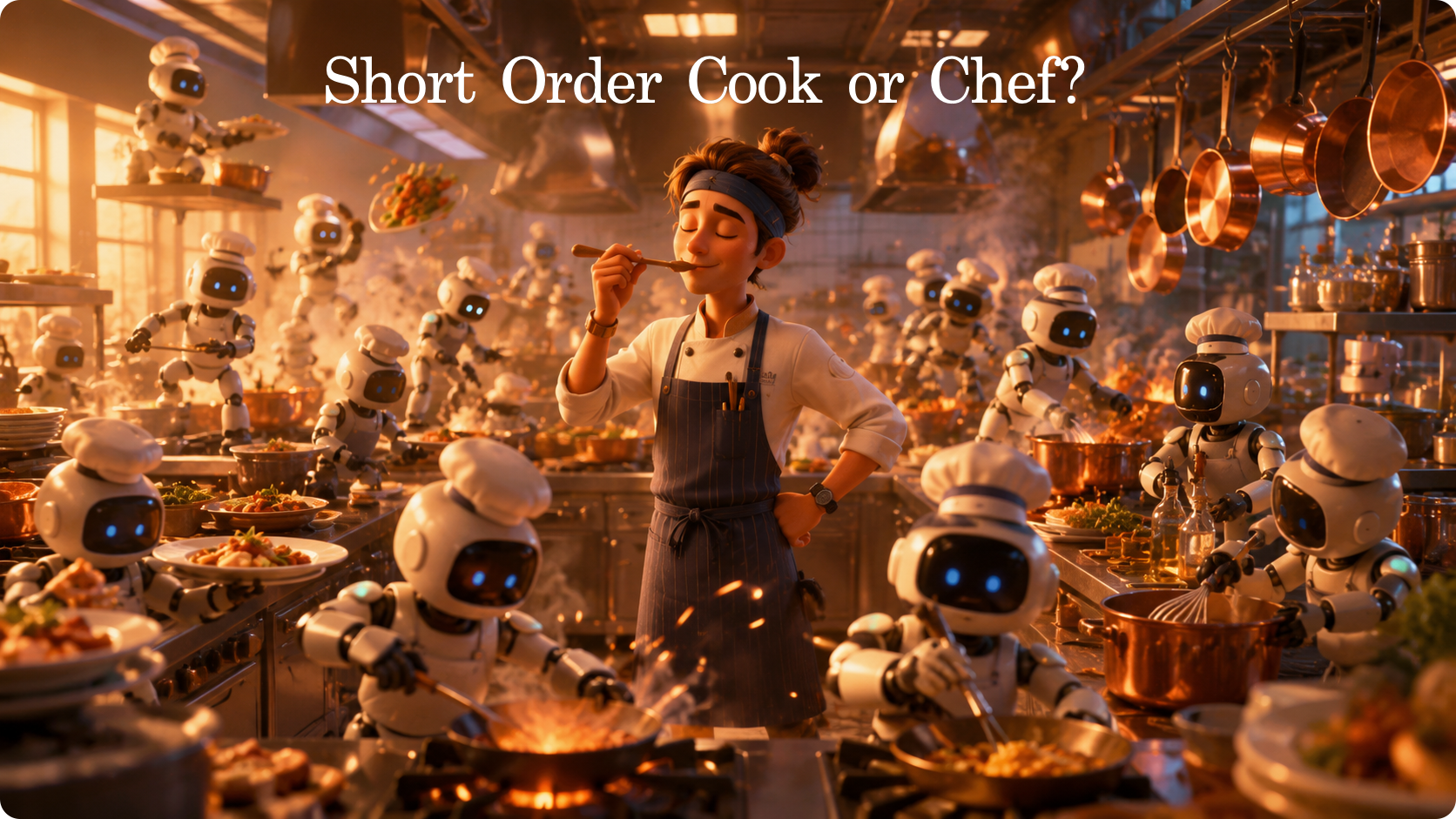
It is the difference between a kitchen full of fast cooks and a chef who knows what they’re making. Both can execute. Only one runs the kitchen.
The Part the Model Can’t Supply
A year of retraining teams has taught me the same thing over and over: technology fluency is rarely the gap. Process is usually culture wearing a workflow diagram. The real gap is a short list of things no model ships with.
- Judgment. Knowing which call to make when the data is ambiguous and the clock is running.
- Integrity. Owning the outcome even when the model gets the credit.
- Sensemaking. Turning a pile of AI output into a decision someone can actually defend.
- Empathy. Staying anchored to the human on the other end of the feature.
- Curiosity. Asking the next question instead of accepting the first answer.
- Agency. Moving before someone hands you permission.
- Accountability. Being where the outcome lands when the model made the call.
Every one of these is a human behavior, not a feature you can bolt on. AI amplifies whatever you bring. Bring judgment and it compounds. Bring none and it scales the void, faster, with better formatting.
It Was Never About the Tools
Most AI-First strategies don’t fail because the tech is weak. They fail because teams won’t reorganize around people, problems, and behaviors. You can’t slap “add chatbot” on the roadmap and call it a strategy. That’s how you get Frankensoft: a stitched-together mess of features that dazzle in the demo and collapse in real-world use.
Great AI isn’t a retrofit play. It’s a reinvention bet. And the reinvention starts not with models, agents, evals, or tokens per prompt, but with behaviors. How people actually use AI. How PMs and engineers enlist it. And how those two layers meet. (I unpacked the full playbook in Organizing on AI.)
Show Me Something
There’s a version of this that shows up in interviews now. A PM walks in with ten years of discovery work, roadmap scars, and enough prioritization frameworks to wallpaper a medium-sized church. Then someone across the table asks, “Are you a product builder?” And the room gets weird.
The panic is understandable and mostly misplaced. The market isn’t demanding every PM become a full-stack engineer who moonlights as an MLOps goblin. It’s asking something narrower: can you take a fuzzy idea and make it tangible enough that a human can react to it before the company commits real money and real engineering time?
As PMs, we vibe code to learn, not to earn. The prototype isn’t the product. The prototype is the flashlight. It helps you surface the stupid faster. Which leaves one question worth more than half the AI advice clogging your feed: what is the smallest believable version of a behavior I can make tangible and test? (More on that in WTH is a Product Builder?)
That’s the AI-augmented PM. Not a coder in a costume. A product person who can collapse the distance between idea and evidence, and who owns the judgment while the agent does the typing. It’s also why I built Product Manager Skills, an open-source library of battle-tested PM frameworks that teach both you and your agents how to do the work at a professional level. You learn the why. Your agents execute the how. North of four thousand product people have starred it and sent the ladder down to the next PM. That’s what augmentation looks like when you point it at judgment instead of theater.
The Tools Changed. The Physics Didn’t.
One more myth to bury on the way out. Somewhere along the line the internet decided prompts were dead and slash-commands were the new black. /loop. /goal. /batch. /routine. Except nobody skipped a step. They renamed the step and put a slash in front of it. You still have to prompt the loop. You still have to prompt the goal. And the moment you’re prompting a loop, you’re one sloppy instruction away from a runaway that won’t stop, or a batch that quietly burns your context window recomputing the same thing forty times.
Prompting didn’t die. It got a bigger vocabulary. A loop without a ceiling is token hemorrhage. A routine without a receipt is folklore. The discipline is knowing where human judgment belongs in the machinery and putting it there on purpose. The tools changed. The physics did not. (I laid out the four old rules that keep the machinery honest in Prompts Aren’t Dead. They Just Got a Bigger Vocabulary.)
Why This Matters Right Now
The job description changed underneath everyone’s feet about three years ago.
Some people noticed and started doing the new job. Most people updated their title and kept doing the old one.
The scoreboard does not consult your self-assessment.
The PMs who figured out the new job are running the rooms. The ones who didn’t are sitting in those rooms wondering when the decision got made without them. This is not about tools. Everyone has the tools. It is about what you do with them. And what you don’t.
Where This Goes in 2027

Here’s the part I’d bet on. By 2027, “AI Product Manager” stops being a special title, the same way “mobile PM” and “digital PM” quietly stopped being special once the skill became table stakes. When every PM is expected to work with agents, the prefix falls off. What’s left is the noun. Product manager. The one who decides.
Execution keeps getting cheaper. Agents move from assistant to operator, and the job shifts again: you won’t babysit a backlog, you’ll own a roster of agents and answer for what they ship. That’s a management job with no direct reports and full accountability, the strangest org chart most of us will ever draw.
And the theater bill comes due. The Klarna-style walk-backs pile up, the “we replaced the team with AI” press releases get quietly rewritten, and governance stops being the thing you skip to hit the demo date. Receipts, evals, and someone whose name is on the outcome become the boring infrastructure of a serious AI product.
Which means the scarce thing in 2027 is the same scarce thing right now, only priced higher: judgment, integrity, sensemaking, empathy, curiosity, agency, accountability. The tools will keep changing. That list won’t. Learn to run the kitchen, not just the cooks, and 2027 reads like opportunity instead of extinction.
Most AI product management training teaches you to go faster. The Productside course teaches you to go right. Four days. Live. Under 20 seats. The next cohort is forming now.